Trading Signal Pool:
Ensemble Indicators for Better Edge
Most individual indicators have a tiny edge that’s hard to capture alone. A Signal Pool combines dozens of them into a single percentage-based meta-signal. Weak predictors in, strong predictor out.
What a Trading Signal Pool Actually Is
A Trading Signal Pool is an aggregation of individual signals into a single percentage-based meta-signal. On any given bar, the pool reports the percentage of underlying signals that are currently true. Then you build a trading rule on top of that percentage: trade only when the pool is above 67%, or 80%, or whatever threshold the data supports.
The point isn’t to look at one indicator more carefully. The point is to look at many indicators at once and ask a simple question: how many of them agree right now? When dozens of independent signals line up, that’s a different piece of information than any one signal firing on its own. It’s a related idea to the 1-mutant neighborhood in evolutionary biology: a single point of evidence is fragile, but a neighborhood of nearby evidence pointing the same direction is structurally more reliable.

A Worked Example
Start simple. Take three variations of the 2-period RSI:
TRUE
TRUE
FALSE
67%
On any given bar there are four possible states: 0%, 33%, 67%, or 100% of the pool is true. You can trigger a trade only when the pool is at 67% or above. Or only when it’s at 100%. The threshold becomes a parameter you can test across.
Now, three RSI variations from the same indicator family won’t give you much. The real value emerges when you pool dozens of genuinely different signals: mean reversion, trend, volatility, market breadth, intermarket, sentiment, and so on. That’s when the pool starts giving you a more complete picture of the market regime, not just a different lens on one variable.

Why Pool Signals at All
Most of the edge in a traditional technical analysis indicator is so small it’s hard to capture cleanly. The original RSI paper described an indicator that worked beautifully on the data Wilder published it with, and increasingly less well on every market and timeframe since. That’s the story for almost every classical indicator: a small, decaying edge.
Signal Pools give you three ways to push back against that decay: uniqueness, ensembling, and a tolerance for non-intuitive signals. Each is worth a discussion.
Edge Lives in Uniqueness
One of my favorite traders, Jaffray Woodriff of Quantitative Investment Management, has said that to have a real edge you need at least one of three things:
- Unique data
- Unique features or signals
- Unique machine learning
Build Alpha addresses #3 directly with its genetic algorithm and LLM orchestrator. It addresses #1 by supporting non-price-based data, COT data, market breadth, sentiment, options flow, and importable custom data. Signal Pools are a clean way to address #2.
The percentage-based pooled signal is uncommon enough that it counts as a unique feature, even when the underlying signals themselves are well known.
Explainability Is Overrated
A lot of traders need to understand why a strategy works before they’ll trust it. I think this is a serious bottleneck on what kinds of strategies you’re willing to build. With enough sample size and statistical significance, the explanation matters less than the persistence.
I’m not alone. Here’s Jim Simons, the most successful systematic trader in history, on the same point (via Gregory Zuckerman’s The Man Who Solved the Market):
Simons and his researchers didn’t believe in spending much time proposing and testing their own intuitive trade ideas. They let the data point them to the anomalies signaling opportunity. They also didn’t think it made sense to worry about why these phenomena existed.
The Man Who Solved the Market, p. 109
I don’t know why the planets orbit the sun. That doesn’t mean I can’t predict them.
Jim Simons, p. 151
More than half of the trading signals Simons’s team was discovering were non-intuitive, or those they couldn’t fully understand. Most quant firms ignore signals if they can’t develop a reasonable hypothesis to explain them, but Simons and his colleagues never liked spending too much time searching for the causes of market phenomena. If their signals met various measures of statistical strength, they were comfortable wagering on them.
The Man Who Solved the Market, p. 204
Do we need to know exactly why a Signal Pool of a few dozen indicators tipping past 67% improves short-term returns? Simons didn’t worry about it. I don’t think we need to either, as long as the result survives proper validation.
Validation Replaces Narrative
Signals that can’t be explained still have to pass noise tests, walk-forward analysis, vs random benchmarking, and monte carlo simulation. Statistical strength is the substitute for narrative, not an excuse to skip validation.
The Ensemble Argument
Ensembling is a core idea in machine learning and statistical prediction: combine many weak predictors into one strong predictor. The team that won the Netflix Prize did it. Random forests do it. Gradient boosting does it. Almost every Kaggle winner does it.
Woodriff again, on the same idea:
I stumbled upon the winning concept of creating one super-model from a large and diverse group of base predictive models.
Jaffray Woodriff
Years ago I wrote about ensemble trading strategies and added Build Alpha’s ability to combine entire generated strategies into a single ensemble. Signal Pools are the same idea applied one level lower: ensembling individual signals rather than complete strategies. Either approach gives you the same statistical benefit. Pooling at the signal level just gives you another lever.
The practical effect is that “outdated” technical indicators stop being a dead end. RSI on its own may have lost most of its edge. Pooled with twenty other signals from different categories, it becomes a useful contributor again.
Build an OR Signal in One Click
Worth highlighting separately: a Signal Pool is the easiest way to build an OR signal in Build Alpha. Most traders only stack AND conditions. Want to fire when signal A OR signal B is true? Drop both into a Signal Pool and set the threshold above 0%. The pool returns true whenever any selected signal is true, which is exactly what an OR gate does.
TRUE
FALSE
50%
One of two signals true. Pool > 0% fires (OR logic). Pool = 100% would only fire when both are true (AND logic).
OR is just a Signal Pool with a threshold of 1. AND is the same pool at 100%. Everything in between is what makes pooling interesting.
Create a Custom News Filter
Signal Pools also double as a clean way to build news event filters with no extra plumbing. Two patterns, same mechanic, opposite thresholds:
- Trade only on news event days. Add the news events you want to trade into a Signal Pool and require the pool to be greater than 0%. The strategy fires only on bars where at least one of those events is active.
- Avoid news event days. Add the news events you want to avoid into a Signal Pool and require the pool to be less than or equal to 0%. The strategy stands down whenever any of those events is active and resumes normally otherwise.
FALSE
TRUE
FALSE
33%
A pool of three macro events on a Fed Meeting day. Pool > 0% triggers a trade-on-news rule; pool ≤ 0% triggers an avoidance rule. Same three signals, two opposite strategies.
Same pool, same editor, same export. The threshold is the only thing that changes. This is also a clean way to combine news avoidance with a regime or signal filter in one rule rather than stacking multiple filters in the strategy.
Build One in 4 Steps
Build Alpha’s Custom Signal Editor is built specifically to make this fast. No code, no scripting, no compiled language. Four steps from raw idea to a generated strategy.
Step 1 — Open the Custom Signal Editor
File → Custom Signal Editor, or just hit F4. Pick “Pool” as the signal type at the top right and give it a name. Read more about the Custom Signal Editor here.

Step 2 — Add Signals from the Library
Pull from any of Build Alpha’s signal categories. The point of pooling is breadth, so use it: don’t pool five RSI variants, pool across categories. Or try five RSI variants.
Inside any one signal you can also vary parameters. For example, set RSI(N)[O] ≥ V and let N range from 2 to 14, V from 70 to 90, and O across multiple bars. One signal definition becomes dozens of pooled members.

The above shows RSI is above 50 but checks length levels from 2 to 14 stepping by 1.
Hit Plot to visualize the pool on any market. The subplot shows the percentage of pooled signals true on every bar. Switch the symbol dropdown to inspect the pool across different markets without reconfiguring anything.
Step 3 — Convert the Pool into a Trading Signal
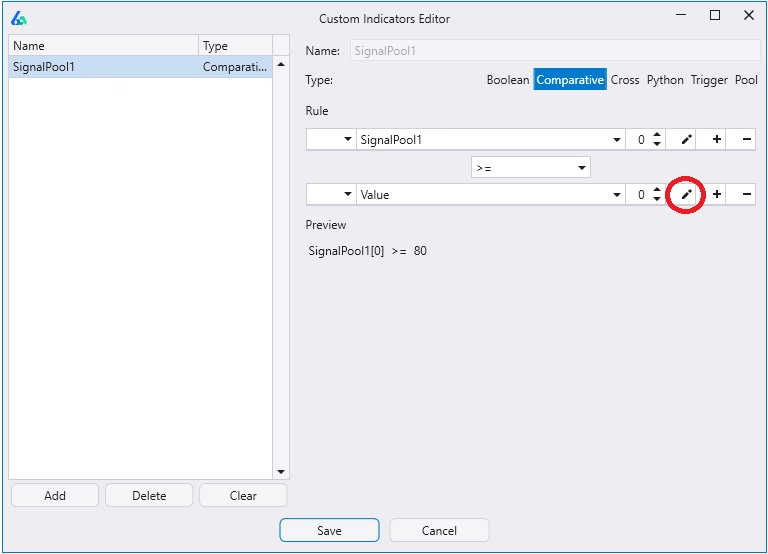
Click Create Signal. Set the threshold rule, e.g., “trade only when the pool is at or above 80%”. Use the pen icon to fine-tune values if needed. Save.
Step 4 — Use the Pool in the Strategy Engine
Your custom Signal Pool now appears in the main Strategy Builder under the Custom Signals group. Use it as an entry, an exit, or require it and let Build Alpha find complementary signals around it.

When a generated strategy uses the pool, Build Alpha automatically embeds the pool definition in the exported code. Whatever language you target, the pool logic is included.

Forex, Stocks, Futures, Crypto: It All Works
Signal Pools are asset-class agnostic. They work on forex pairs, stocks, ETFs, futures, commodities, interest rates, and crypto. Same engine, same threshold logic, same export.
I’d push back gently on traders who only trade forex (or only trade any one asset class). The forex world in particular is heavy on technical-analysis-as-ritual and signal vendors selling thinly disguised lottery tickets or short-vol strategies. Building your own strategies is the cleanest way to step out of that noise. The threshold either holds up across robustness tests or it doesn’t, and you don’t owe anyone a subscription either way.
Automating a Signal-Pool Strategy
Build Alpha generates fully automatable strategy code for every major retail and pro platform:
Build Alpha also connects to your live data broker so you can monitor positions, P&L, and trade alerts on any pool-driven strategy. As always, run any new strategy through the full robustness testing pipeline before going live.

The Honest Caveat
Pooling weak signals doesn’t manufacture edge. If none of the underlying signals carry information for the market and timeframe you’re testing, the pool likely won’t either. The benefit comes from breadth and statistical aggregation across signals that each have at least a small, consistent edge. Garbage in, garbage out. The validation pipeline is what tells you which is which.
Takeaways
One Number, Many Signals
A Signal Pool is the percentage of underlying signals true on each bar. Dozens of inputs, one composite output.
Threshold = Trading Rule
≥ 67%, ≥ 80%, exactly 100% for AND, or > 0% for OR. The threshold is the only thing that changes the strategy.
Breadth Beats Depth
Pool across categories — mean reversion, trend, volatility, breadth, intermarket — not five variants of the same indicator.
Ensembling Is the Point
Pools turn weak predictors into a stronger composite, the same mechanism behind random forests and Kaggle-winning models.
Statistics > Narrative
You don’t need to explain why a pool works. Robustness validation — noise, walk-forward, monte carlo, vs. random — does the work narrative can’t.
Four Steps, No Code
Open the editor, add signals, set the threshold, generate strategies. Build Alpha embeds the pool in the exported code automatically.
Summary
Everyone gets the same market data and looks at it through more or less the same indicators. The edge that’s left in classical technical analysis is small and decaying. Signal Pools are a way to combine many of these “weak” predictors into a single composite signal that carries more information than any individual indicator on its own. They give you a unique feature, in Woodriff’s sense, without requiring unique data or unique machine learning. They make OR logic trivial. And they let you keep using familiar indicators while extracting more signal from them than the indicators alone would provide.
Build Alpha builds, validates, and exports them in a few clicks. Worth a place in the toolkit.
To learn more about how AI can drive strategy generation with Build Alpha, read about the LLM Orchestrator here. Coming soon…

David Bergstrom
A decade-plus in professional trading as a market maker and quantitative strategy developer at a high-frequency trading firm with a CME seat. Consulting for hedge funds, CTAs, family offices, and RIAs. Self-taught C++, C#, and Python programmer specializing in data science, machine learning, and trading strategy development.
Frequently Asked Questions
What is a Trading Signal Pool?
A Trading Signal Pool is an aggregation of multiple individual signals into a single percentage-based meta-signal. On any given bar, the pool returns the percentage of underlying signals that are true. You can then trigger a trading rule when that percentage crosses a threshold (e.g., trade only when 80% or more of the pool is true).
Why use a Signal Pool instead of a single indicator?
Most individual technical indicators have a small edge that’s hard to capture on its own. Pooling many signals together (an ensemble) is a well-known statistical method for turning weak predictors into a stronger one. It also gives you broader market context, reduces dependence on any single signal, and uncovers patterns most traders aren’t looking at.
Can a Signal Pool be used to build OR conditions?
Yes. Set a Signal Pool threshold above 0% and the pool returns true whenever any of the underlying signals is true. That’s an OR signal. Most traders only build AND signals (signal A AND signal B). Signal Pools make OR logic just as easy.
Does a Signal Pool work for forex, stocks, futures, and crypto?
Yes. Signal Pools work on any market with OHLC data, including forex pairs, stocks, ETFs, futures, commodities, interest rates, and cryptocurrencies. The methodology is asset-class agnostic.
What signals can I include in a Signal Pool?
Build Alpha lets you pool from over 7,000 built-in signals across 17+ categories: price action, technical indicators, chart patterns, seasonality, COT data, market breadth, sentiment, intermarket, volatility, multi-timeframe, options flow, news, weather, and more. You can also include custom Python signals.
Do I need to know why a Signal Pool works?
No. As Jim Simons and many other quant practitioners have shown, statistical significance and out-of-sample stability matter more than narrative explainability. If a Signal Pool passes robustness tests (noise, walk-forward, vs random, monte carlo), it’s worth including in your trading model regardless of whether you can intuit why.
Can a Signal Pool be automated and exported to a trading platform?
Yes. Build Alpha automatically generates fully automatable code for TradeStation, NinjaTrader 8, MultiCharts, MetaTrader 4, MetaTrader 5, TradingView Pine Script, ProRealTime, and Python (Interactive Brokers). Your Signal Pool logic is embedded directly into the generated strategy code.
What Traders Say About Build Alpha




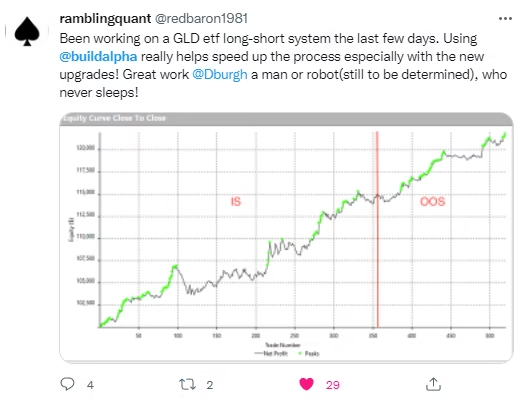









Explore More
Ready to BUILD ALPHA?
See Signal Pools running on real strategy generation.